
Manufacturing Certainty in Hiring
Most hiring challenges aren’t caused by a lack of talent. They’re caused by a lack of signal.
As businesses grow, hiring decisions carry more weight, move faster, and create longer-lasting consequences. Yet many teams still settle for inputs that are easy to access: resumes from job boards, network connections, and pattern matching the status quo rather than creating new criteria that actually predict success.
The result is a false constraint: “The market is narrow.”
In reality, the market is usually wide. The market is just inadequately being evaluated.
Why Resumes and Networks Create False Confidence

Resumes tell you where someone has been.
Networks tell you who you already know.
Neither reliably tells you how someone will perform in your seat, in your business, at this stage of growth.
This is especially true in the lower middle market, where roles are broader, resources are tighter, and leadership styles matter as much as functional expertise. Hiring someone who has “done the job before” may feel safer, but often you’re just paying a premium for familiarity, not fit.
The real challenge is not hiring based on hard skills or culture fit.
It’s understanding how the two interact.
The Dual Hard + Soft Skills Problem
Most hiring processes overweight one side of the equation. Some obsess over hard skills: exact experience, specific tools, prior titles, etc. Others lean heavily on soft skills: leadership presence, culture fit, intuition, etc.
Both approaches fail in isolation.
Hard skills without soft skills break under pressure.
Soft skills without hard skills stall execution.
High-confidence hiring requires evaluating both at the same time, against the actual demands of the role. How do you assess this? We’re glad you asked.
Meet the CCRB: Candidate Criteria + Role Benchmarking
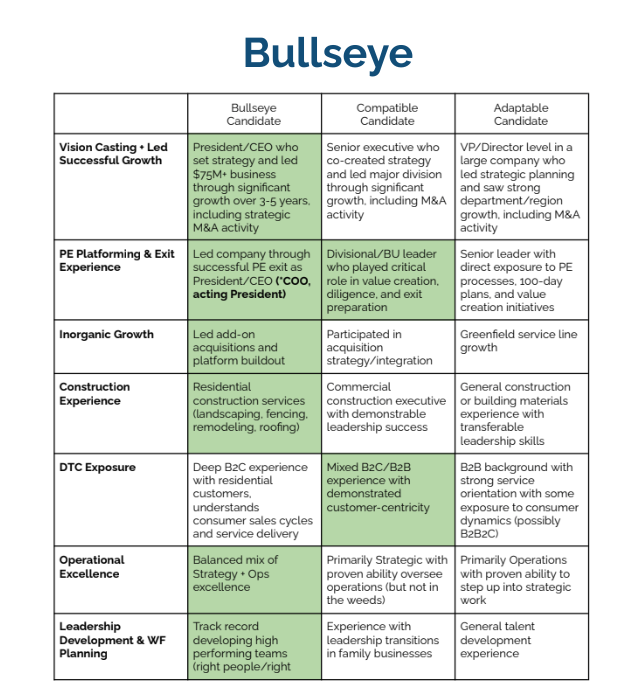
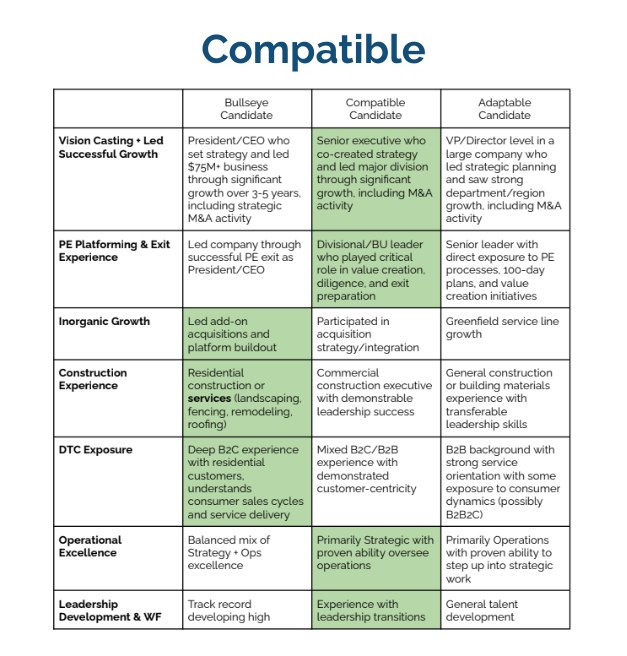
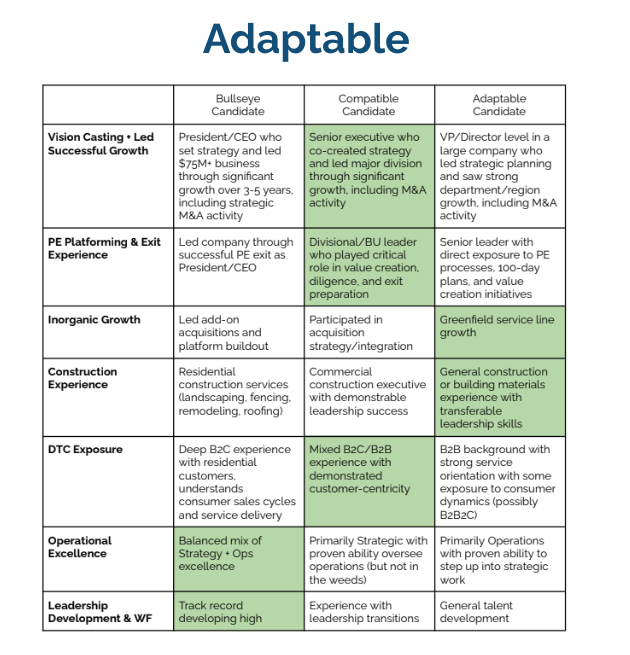
At 10th St. Talent, we anchor every search around a Candidate Criteria & Role Benchmark (CCRB) — a structured framework that translates business needs into hiring signals. This is built collaboratively between our recruiting experts and our clients during the first two weeks of the search process and is essential to successful outcomes.
Before candidates ever enter the picture, we align on:
Mission-critical outcomes for the role
A hard skills matrix tied directly to those outcomes
A soft skills benchmark grounded in decision-making, adaptability, and leadership behavior
Candidates are then evaluated holistically across both dimensions, allowing us to distinguish between:
Bullseye candidates with strong alignment
Compatible candidates with clear, manageable tradeoffs
Adaptable candidates with high upside and growth potential
This approach creates clarity without narrowing the market prematurely.
How Clear Criteria Actually Expand the Market
One of the biggest misconceptions in hiring is that raising the bar shrinks the funnel.
In practice, we find the opposite is true.
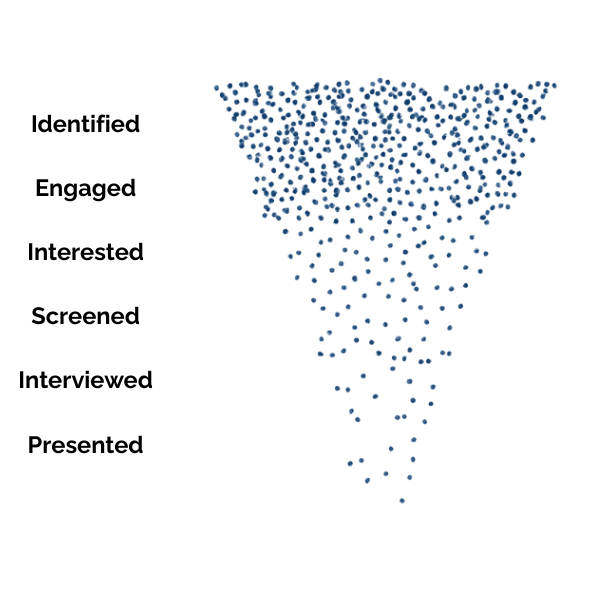
When criteria are vague, teams default to proxies (pedigree, familiarity, surface-level experience) that eliminate strong candidates for the wrong reasons. Clear benchmarks allow you to widen the top of the funnel while remaining disciplined at the bottom.
This is how you open the market without lowering standards. The funnel isn’t the strategy. It’s the outcome of well-defined criteria applied consistently.

From Market Coverage to Confident Decisions

Once the CCRB is established, the hiring process becomes far more objective:
Targeted market mapping replaces network dependency
Structured screening replaces gut feel
Candidate comparisons make tradeoffs explicit rather than implicit
Instead of choosing between “good and good,” decision-makers see:
Where each candidate is strong
Where each candidate stretches
What risks are being accepted — and why
Transparency is what creates confidence.
Why This Matters for Growing Businesses
As organizations scale, the cost of a mis-hire compounds quickly — not just financially but culturally and operationally.
High-confidence hiring comes from slowing down and providing clarity, structure, and alignment upfront.
By combining hard skills, soft skills, and market coverage into a single evaluation framework, hiring stops being a leap of faith and starts feeling more like disciplined decision-making.
At 10th St. Talent, this approach is operational, not aspirational. The CCRB is how we translate business needs into hiring signals. Market coverage is how we ensure opportunity isn’t artificially constrained. Structured evaluation is how we turn tradeoffs into informed decisions. This is how we help growing businesses replace hiring uncertainty with conviction.